
Business Continuity
Business Continuity Planning
A Business Continuity Plan (BCP) is essential for every company to ensure stability, resilience, and long-term success. It outlines the strategies and procedures a business must follow to continue operations during unexpected disruptions such as natural disasters, cyberattacks, or system failures. Having a solid BCP in place helps minimise downtime, protect critical data, and maintain customer trust.
In today’s fast-paced business environment, even a short interruption can lead to significant financial losses and reputational damage. A well-developed business continuity strategy ensures that your organisation can quickly recover from crises, keep essential functions running, and safeguard employees and stakeholders. By proactively preparing for potential risks, companies can reduce vulnerabilities and maintain a competitive advantage.
Implementing a business continuity plan isn’t just about crisis management, it’s about building resilience, compliance, and confidence in your business operations.
Why use a Business Continuity data management system?
By implementing a robust, reliable, intuitive business continuity system, your business can enhance data accuracy, strengthen compliance, and build long-term operational resilience.
One centralised database
One location for all your employees to store, monitor & manage information in real time. This can critial during a severe business disruption or disaster.
Eliminates the risks of outdated data
No longer need to worry about juggling multiple Excel spreadsheets with outdated files, version conflicts and scattered data sources.
Great for employee collaboration
Our BC system improves collaboration across departments and supports quick decision-making during disruptions.
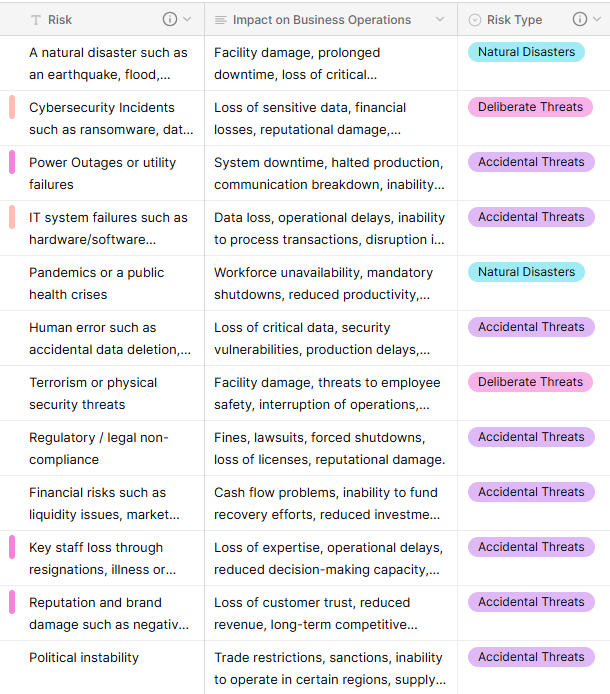
What's Included In Our Business Continuity System
BIA (Business Impact Analysis)
A critical process that helps identify & evaluate the potential effects of disruptions on essential business activities, their departments & their applications used.
- Identifies critical business activities to prioritise during disruptions
- Strengthens resilience by preparing effective recovery strategies
- Minimizes downtime and supports faster, more confident decision-making
Risk Assessment
Identifies & evaluates potential threats such as cyberattacks, natural disasters or equipment failures, that could disrupt business operations, with their likelihood & impact.
- Identifies potential threats before they impact operations
- Strengthens preparedness with proactive risk mitigation strategies
- Enhances business resilience and ensures smoother recovery after disruptions
Incident Management
Ensures the business can respond quickly to unexpected events or disruptions by having clear processes in place for identifying, reporting & resolving incidents.
- Ensures rapid response, quickly containing and resolving unexpected incidents
- Minimises disruption, keeps critical operations running smoothly during crises
- Builds resilience, strengthens organisational readiness and stakeholder confidence
Proud Partners of Baserow.io
We build using Baserow, here's why...
- 5x cheaper than other systems + fully customisable
- Power of a relational database, with the familiarity of a spreadsheet
- Developer-friendly and API-first
- Collaborate in real-time across teams
- Easily import and export your data
- Highly performant with large volumes of data

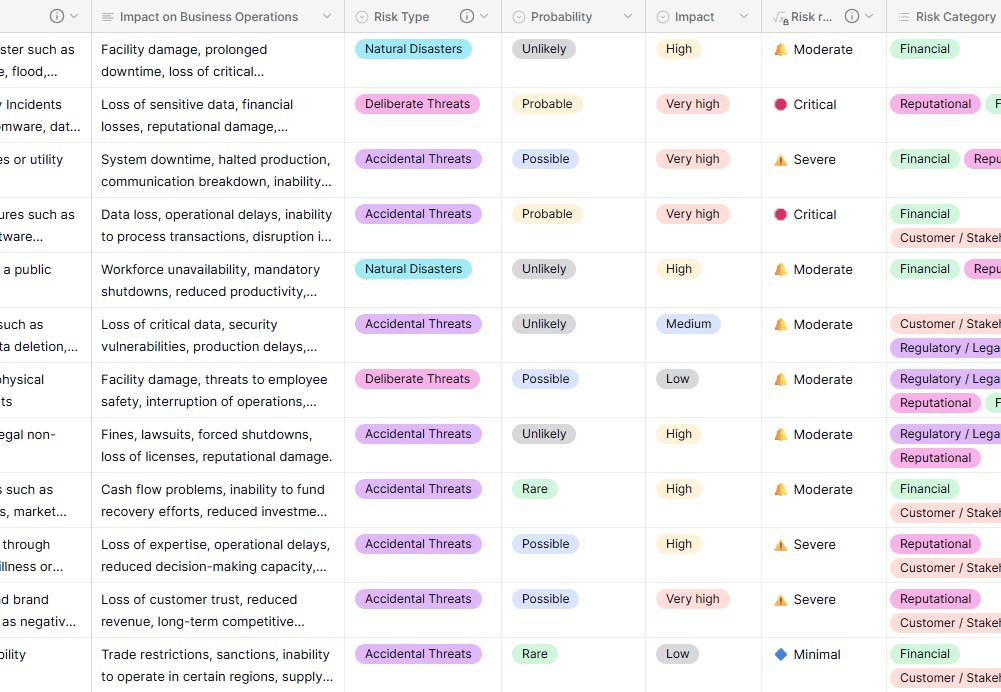
What we've built...
- Business Continuity specific database that includes a BIA table, risk assessment and incident management tables plus much more
- Fully customisable with the ability to adapt to your own Business Continuity needs
- Built using the latest, advanced technologies with new updates regularly
Compliance & Regulations
ISO 22301 & Why Businesses Need to Be Compliant
ISO 22301 is the international standard for Business Continuity Management Systems (BCMS). It provides a structured framework that helps organizations prepare for, respond to, and recover from unexpected disruptions such as cyberattacks, natural disasters, supply chain failures, or pandemics.
By implementing ISO 22301, businesses can ensure that critical operations continue even in times of crisis, minimising downtime and protecting their reputation.
Although being ISO 22301 compliant isn’t mandatory for most businesses, it is strongly recommended and sometimes required by certain clients, regulators, or industries.
Our system provides you with a cost-effective, centralised location to store, manage and work with you Business Continuity data, helping you become ISO 22301 compliant.
Reduced Downtime & Financial Loss
By having well-defined recovery procedures in place, businesses can minimise downtime, protect revenue & reduce the financial impact of unexpected events like IT outages, cyber attacks or natural disasters.
Enhanced Business Resilience
Demonstrates an organisation has robust risk management and recovery strategies in place. It helps build trust with clients & regulators by proving that the business can maintain essential services under adverse conditions.
Strengthens customer confidence
ISO 22301-certified organisations are seen as more reliable and secure, giving them a distinct advantage when bidding for contracts or attracting customers who prioritise stability and risk management.
What is DORA & Why It Matters
The Digital Operational Resilience Act (DORA) is an EU regulation designed to strengthen the digital resilience of financial institutions and their service providers. It ensures that banks, insurers, investment firms, and critical third-party ICT providers can withstand, respond to and recover from cyber threats and IT disruptions.
DORA establishes a unified framework for managing ICT risks, mandating robust cybersecurity, incident reporting, testing and third-party risk management across the EU’s financial sector.
For businesses, compliance with DORA is essential to protect operational continuity, safeguard customer data and maintain trust and regulatory compliance. It not only reduces the risk of costly downtime and reputational damage but also ensures organizations are prepared for today’s evolving digital threats.
Our system provides you with a cost-effective, centralised location to store, manage and work with you Business Continuity data, helping you become DORA compliant.
Strengthens cybersecurity and ICT resilience.
Enhances regulatory compliance and transparency.
Improves incident response and recovery capabilities.
Builds customer and stakeholder trust.
Our Workflow
Request a demo
Click the button below to request a demo of our system and we will be in touch.
We will start building
We will start building your own system tailored to your business requirements.
Handover and training
Once built, we will handover the system to your team and train your staff members.